How does overhead lighting affect your evening cortisol levels?
Overhead indoor lighting mimics the high angle of the midday sun, sending evolutionary distress signals to your brain that stimulate cortisol and trigger daytime alert chemistry. Shifting light sources below eye level—specifically to the bottom 18 inches of your living space—fosters an automatic biological wind-down by replicating ancestral campfire conditions.
In our modern homes, we treat light as a utility—something to toggle on when a room grows dim. Yet to the human nervous system, light is never just a utility. It is an environmental command.
In this website, under the umbrella of Domestic Ecology, I explore how the architectural and environmental design of our immediate spaces either harmonizes with or disrupts the human instrument. One of the most pervasive, yet invisible, stressors in the contemporary home is overhead artificial lighting past twilight.
To understand why your ceiling fixtures might be keeping your nervous system in a state of high alert, we have to look downward—to the concept of the Circadian Floor.
The Evolutionary Angle: Midday Skies vs. Campfire Glow
For hundreds of thousands of years, our ancestors interacted with light across two distinct spatial planes:
- The Overhead Sun: High-angle, blue-spectrum light delivered from above signaled peak safety, hunting hours, and optimal midday alert chemistry.
- The Ground-Level Fire: Once the sun dipped below the horizon, the only light source available was the campfire. It was low-angle, warm, amber, and strictly bound to the floor.
Your biology is deeply attuned to these spatial geometry cues. When you flip on a flush-mount ceiling light or a bright chandelier at 8:00 PM, your intrinsically photosensitive retinal ganglion cells (ipRGCs) register the angle of the light just as much as its intensity.
Overhead lighting signals to the brain that it is high noon. The body responds accordingly: it sustains daytime alert chemistry, halts the natural production of melatonin, and keeps your evening cortisol levels artificially elevated.
The Cortisol Conundrum
Cortisol is our primary hormone of adaptation and alertness. It is designed to spike sharply in the morning to wake us up, gently cascading downward as the day comes to a close.
When evening cortisol remains high due to overhead light pollution, your nervous system cannot drop into the parasympathetic “rest and digest” state. You don’t just struggle to fall asleep; you enter sleep with a baseline of systemic friction, waking up unrefreshed and out of sync with your natural rhythms.
The Practical Fix: Constructing the 18-Inch Circadian Floor
The solution is not to sit in pitch darkness after dark, but rather to shift the architecture of your lighting to mimic our ancestral ecology.
The Rule: Past 7:00 PM, transition all light sources to the bottom 18 inches of your living space.
By systematically turning off the ceiling fixtures and activating a lower spatial plane, you create an automatic, passive biological wind-down. Here is how to apply this in your home:
- Low-Lux Floor Lamps: Utilize floor lamps with heavy, opaque shades that direct light downward rather than outward or upward.
- Under-Cabinet and Baseboard Strips: Install warm-spectrum (2200K–2700K) low-lux LED strips along the undersides of cabinets, behind furniture, or along baseboards.
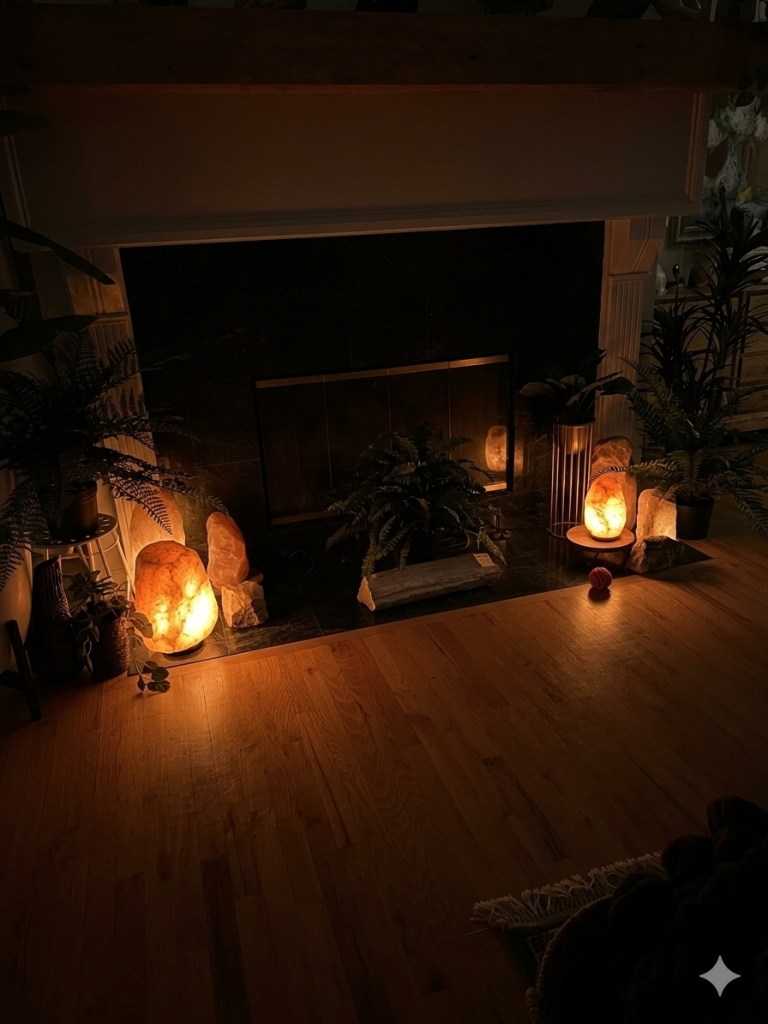
- True Candlelight or Salt Lamps: Place low-wattage amber light fixtures, salt lamps, or beeswax candles directly on the floor or low hearths. The photo at the top of the page is my own home, with salt lamps flanking the fireplace (and the dogs’ ball hanging out on the side). Believe me, I walk the walk here!
Sinking into Coherence
When you drop the light line below eye level, you change the resonance of the room. The mind perceives the “ceiling” of darkness as a blanket of safety, triggering a rapid drop in evening cortisol and welcoming a deep, natural evening transition.
By designing a domestic ecology that respects our evolutionary blueprints, we stop fighting our biology and allow our systems to rest. This is an easy, low-cost way to help your body rest more fully and easily, as nature intended.
References & Scientific Grounding
- [1] Provencio, I., et al. “A Novel Human Opsin in the Inner Retina.” The Journal of Neuroscience. This foundational study identified melanopsin within intrinsically photosensitive retinal ganglion cells (ipRGCs), proving the inner retina has its own independent light-sensing network dedicated entirely to tracking environmental illumination angles and blue-light spectrums rather than conscious image forming.
- [2] Garaulet, M., Scheer, F. A., et al. “Interplay of Dinner Timing and MTNR1B Type 2 Diabetes Risk Variant on Glucose Tolerance and Insulin Secretion.” Diabetes Care. This clinical trial demonstrates how introducing light and carbohydrate inputs concurrently during the evening phase artificially triggers daytime chemistry, forcing elevated systemic cortisol and disrupting natural hormonal cascades.
- [3] Xiao, Q., Figueiro, M. G., et al. “Alignment Between 24-h Light-Dark and Activity-Rest Rhythms Is Associated With Glucose Metabolism.” Diabetes Care. A large-scale physiological study tracking the consequences of modern light-dark misalignment, demonstrating that exposure to high-angle overhead light sources past twilight induces baseline systemic friction and blocks the parasympathetic transitions required for deep restorative sleep.