How does watching TV at night under bright overhead lights affect your sleep and anxiety?
Watching TV at night while exposed to bright overhead kitchen or living room lighting disrupts your human biology by suppressing melatonin production and raising cortisol levels. While television screens emit disruptive artificial blue light, combining them with high-angle, overhead room lighting tricks the brain's master clock into believing it is daytime. This artificial environment forces the autonomic nervous system to remain in an alert, fight-or-flight pattern, leading to evening anxiety and sleep fragmentation.
For modern humans, evening hours are meant to be a slow descent into physical rest. Yet, for most of us, our domestic habits create a state of what amounts to neurological confusion. We cook dinner under high-power overhead LEDs in the kitchen, and then move to the living room to watch television with ceiling lights shining full blast.
If you frequently feel anxious, restless, or “wired but tired” past 8 PM, your environment is likely overriding your internal rhythm.
The Biological Trap of Evening Television
Many people understand that electronic screens emit artificial blue light, which can negatively impact sleep cycles. However, the physical environment around the television is often what breaks our baseline equilibrium.
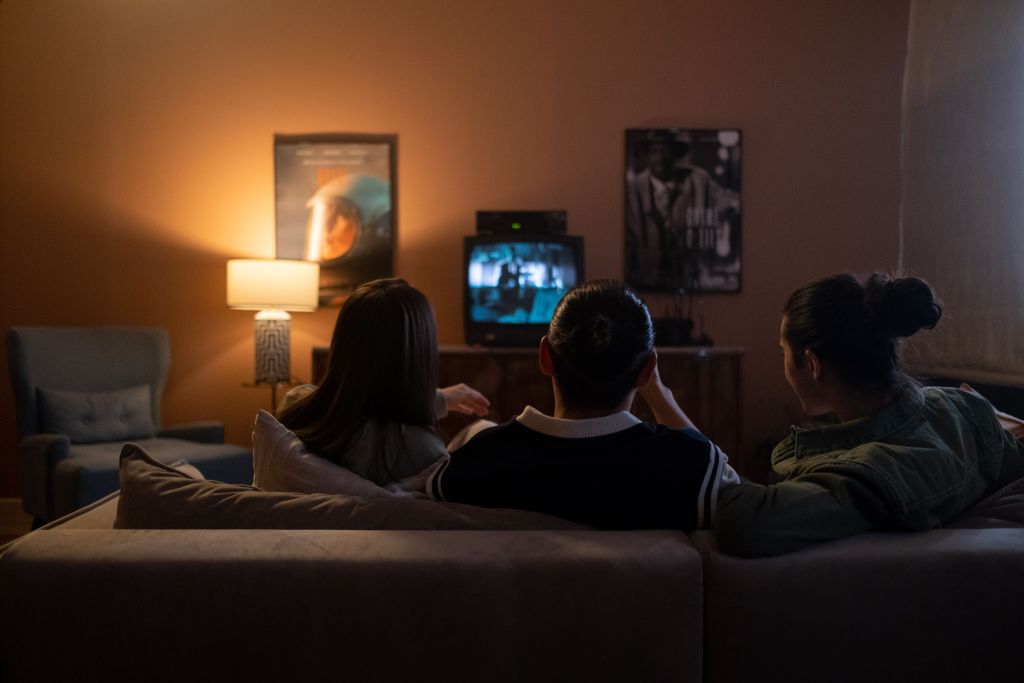
When you sit in a dark or dimly lit room to watch television, your pupils naturally dilate. If you turn on bright, high-lux overhead lights to compensate, or leave the kitchen lights streaming into your living space, you subject your retinas to a massive flood of artificial wavelength inputs.
The human eye contains specific circadian photoreceptors called ipRGCs. These cells do not handle vision; they handle timing. They are highly sensitive to blue light and high-angle light coming from above—mirroring the midday sun. When these receptors are triggered after dark, your brain immediately halts the natural production of melatonin. Your body cannot down-regulate because, biologically, it thinks it’s high noon.
Engineering a Low-Stimulus Evening Habitat
Okay, let’s talk reality. Most of us (even me!) watch something on television most nights. You don’t need to throw away your television or sit in total darkness to support your body. Instead, just change the physical architecture of the light in your home after 6 PM.
To signal your nervous system that it’s safe to wind down, implement two practical environmental shifts:
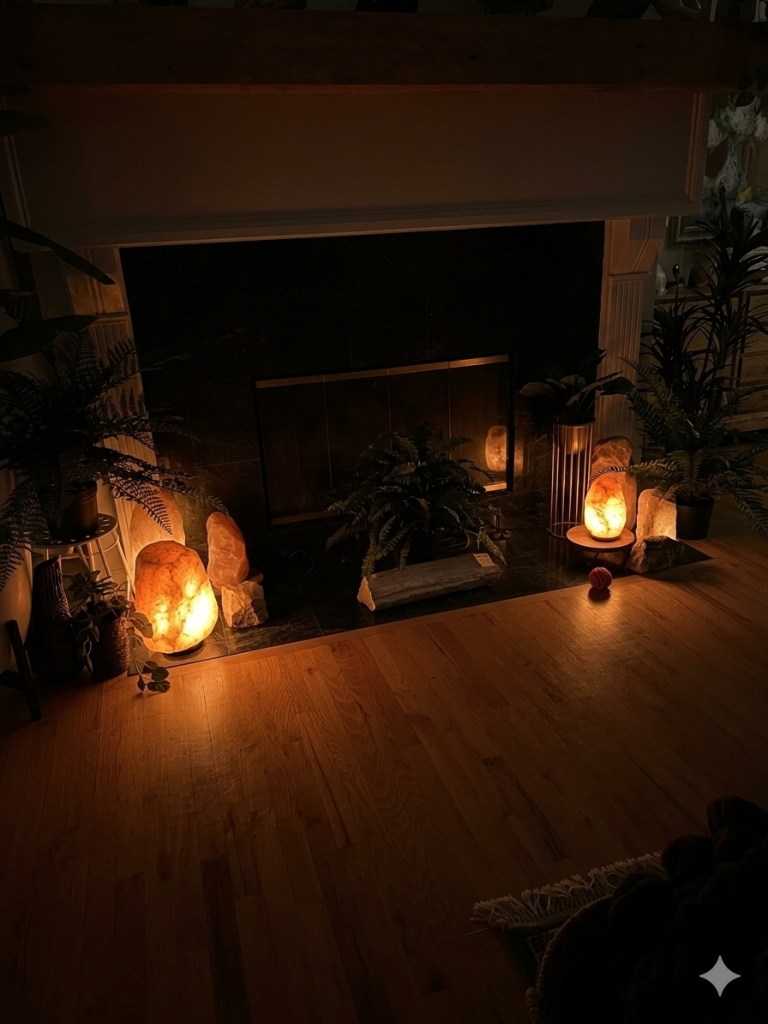
- Drop the Light Angle: Turn off all ceiling and overhead lights in both the kitchen and living room. Switch entirely to floor lamps or small table lamps placed at or below eye level. Low-angle light mimics the setting sun, which naturally prompts your brain to begin its wind-down sequence.
- Shift the Bulb Temperature: Replace standard white or blue-toned LED bulbs in your living spaces with warm amber or low-wattage incandescent bulbs. These tones lack the high-energy wavelengths that trigger cortisol release, allowing your autonomic nervous system to shift from a daytime alert state into a calm, parasympathetic rest state. I LOVE the special warm amber ones they sell on Amazon. Search for “warm amber sleep lights” to find your favorite. I even use the warm amber nightlights because they keep your body sleepy if you have to get up during the night.
By taking control of the physical inputs in your kitchen and living room, you allow your body’s natural pattern recognition to function without interference. You stop forcing your nervous system to fight its environment, allowing it to return to its natural biological center. And that is your biology working exactly as it should.
🔬 Physiological Logs & References
- Retinal Circadian Pathways: Berson, D. M., Dunn, F. A., & Takao, M. (2002). Phototransduction by Intrinsically Photosensitive Retinal Ganglion Cells. Science, 295(5556). [The foundational discovery of mammalian ipRGCs and their direct, non-visual monosynaptic retinohypothalamic path to the brain’s master biological clock].
- Light Angle Dynamics: Hattar, S., et al. (2006). Melanopsin-Expressing Retinal Ganglion Cells: Architecture and Circuitry. Journal of Comparative Neurology, 497(3). [Neurobiological mapping showing how high-angle, overhead visual stimuli specifically activate the ipRGC field to suppress melatonin production and raise autonomic cortisol metrics].
- Wavelength Architecture: Gooley, J. J., et al. (2010). Exposure to Room Light Before Bedtime Suppresses Melatonin Onset and Shortens Melatonin Duration in Humans. The Journal of Clinical Endocrinology & Metabolism, 95(12). [Clinical human data modeling how standard high-lux indoor lighting environments track as a daytime signal, causing sleep fragmentation and autonomic sympathetic alert loops].